Agentic AI for Events: What It Means When AI Can Plan and Execute Tasks
8 min read
Quick answer
Agentic AI for events means AI that takes actions on your behalf without needing to be prompted for each task. In 2026, it is being used for post-event follow-up, content distribution, and registration sequences, not yet for full event management.
Most AI tools you use today wait for you to ask them something.
You write a prompt. The AI writes a response. You copy it, check it, and move on. That back-and-forth is useful, but you are still doing the coordination. You are still the one deciding what to ask next, what to do with the answer, and how to connect the output to the next task.
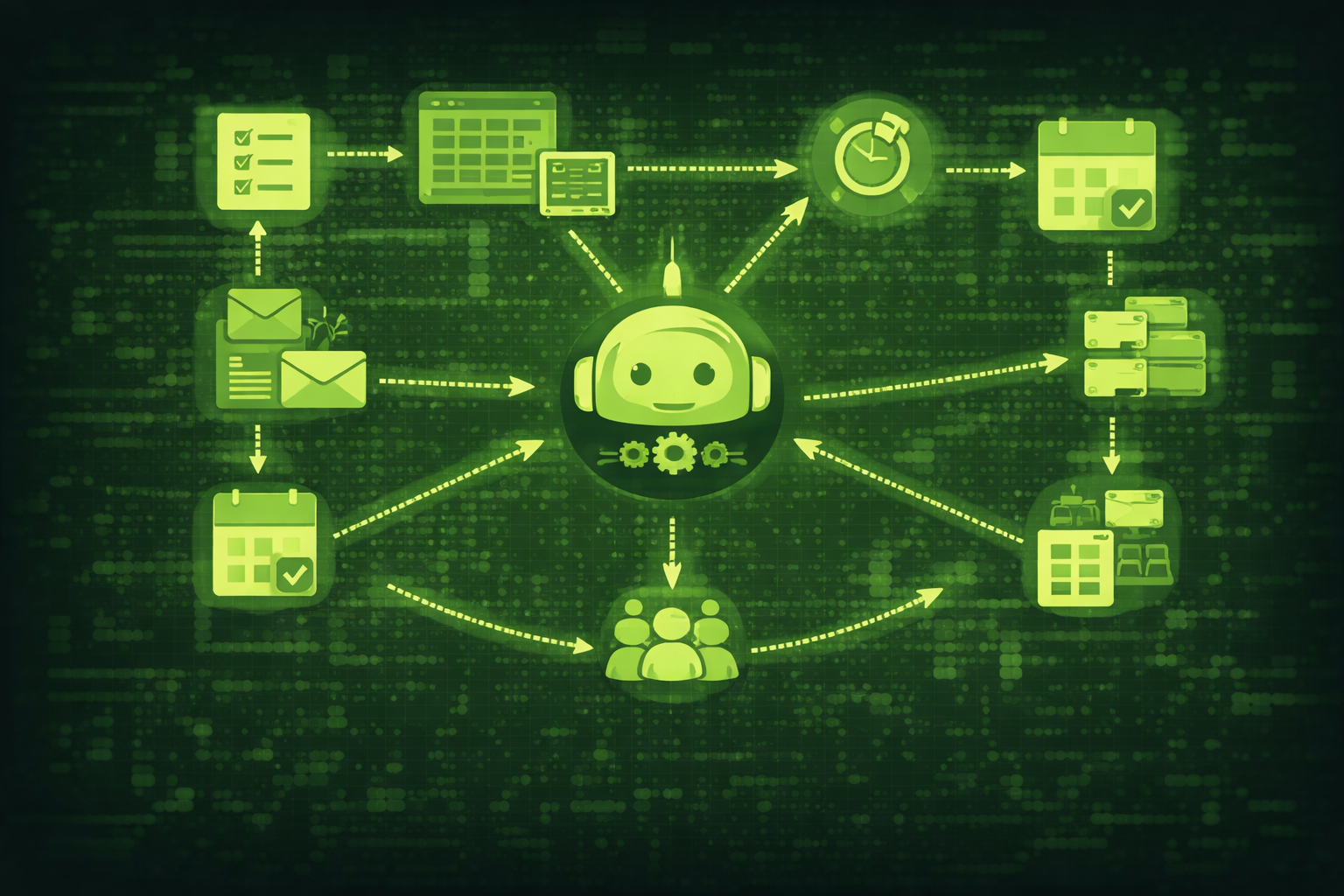
Agentic AI is different. You give it a goal. It figures out the steps, takes action across multiple tools, checks its own work, and adjusts when something does not go as planned. You are not writing prompts for every step. You are setting an objective and reviewing the result.
This is a significant shift for event planners. Not because it is happening tomorrow, but because parts of it are already working in 2026 and the rest is coming faster than most people expect.
Deloitte predicts that 25% of companies using generative AI will launch agentic AI pilots in 2026, growing to 50% by 2027. Organisations implementing agentic workflow automation report 30 to 50% reductions in process time. Source: Deloitte, 2026 and OneReach.ai, 2025.
What is agentic AI?
Agentic AI refers to AI systems that can plan and execute a sequence of actions to achieve a goal, without needing a human to guide every step. The word agentic comes from agency, which means the ability to act independently.
A regular AI tool like ChatGPT responds to one prompt at a time. An agentic AI system takes a higher-level objective, breaks it into a series of sub-tasks, executes those tasks using tools and APIs, checks the results, and continues until the goal is achieved. If something goes wrong at one step, it adjusts and tries a different approach.
The difference in plain terms
Regular AI: you ask 'write me a speaker briefing document for this event'. The AI writes it. You copy it into a document and send it. Agentic AI: you say 'prepare and send speaker briefing documents for all 12 confirmed speakers'. The agent pulls the speaker list from your event platform, drafts a personalised briefing for each person based on their session details, creates 12 individual documents, and sends them via email. You review the log and approve.
What can agentic AI already do for event planners in 2026?
It is important to be honest about where agentic AI is right now. The fully autonomous event planner that runs your entire conference without human input does not exist yet. What does exist is a set of specific, constrained agentic workflows that are already running in real event organisations.
Speaker and attendee communications
EventMobi has demonstrated an AI agent that calls event registrants the night before an event to confirm attendance and answer questions. The agent handles the call, processes the responses, and updates attendance records automatically. A workflow that previously required a team member to spend 2 to 3 hours on calls now runs overnight without human involvement.
Content and session asset management
Event production companies like Tree-Fan Events are testing agents that manage speaker bios, intake forms, and session assets. The agent compiles information from multiple sources into a central database, flags missing pieces, and sends reminder messages to speakers who have not submitted their materials. It does not wait to be told a deadline has passed. It monitors the deadline and acts.
Registration and attendee onboarding
Agentic registration workflows can classify attendee profiles on arrival, trigger personalised welcome sequences, add registrants to the correct matchmaking pool, and send targeted pre-event content based on their stated interests. The entire sequence from registration to personalised onboarding runs without a human writing a single email.
Post-event reporting
After the event, an agentic system can pull data from your registration platform, survey tool, matchmaking platform, and social media analytics, combine them into a structured report, and send a first draft to the event organiser within 24 hours. This is not a template. It is a real synthesis of real data from multiple sources, structured and written by the agent.
| Task | Status in 2026 | Tool or platform |
|---|---|---|
| Pre-event attendee confirmation calls | Available now | EventMobi, Lindy |
| Speaker asset collection and chasing | Available now | n8n, EventMobi, custom agents |
| Personalised registration onboarding sequences | Available now | Bizzabo, Whova, HubSpot AI |
| Post-event report generation from multiple data sources | Available now | Custom AI workflows, Snapsight |
| Autonomous venue sourcing and RFP sending | Early stage | Experimental workflows in 2026 |
| Full run-of-show management on event day | Not ready yet | 2027 and beyond |
| End-to-end budget negotiation with suppliers | Not ready yet | Requires human judgment |
How does an agentic AI workflow actually work?
An agentic AI system works through a continuous loop of four stages: perceive, plan, act, and reflect.
Perceive: the agent gathers information from connected tools and data sources. For an event planner, this might mean reading your registration data, your calendar, your email inbox, and your event platform.
Plan: the agent breaks the goal into a sequence of sub-tasks and decides which order to execute them in. It considers what it knows, what it needs to find out, and what tools it has access to.
Act: the agent executes the sub-tasks. This might mean sending emails, updating records, generating documents, or calling external APIs.
Reflect: the agent checks whether the action produced the expected outcome. If something went wrong or is incomplete, it adjusts the plan and tries again.
This loop continues until the goal is achieved or the agent determines it needs human input to proceed. That last point is important. Good agentic AI systems are not designed to operate without any human oversight. They are designed to handle the straightforward steps autonomously and escalate to a human when they encounter something that requires judgment.
What tools can you use to build agentic workflows for events today?
You do not need to be a developer to start experimenting with agentic AI for events. Several tools make it accessible for non-technical users.
n8n
n8n is an open-source workflow automation tool that lets you connect apps and services with visual workflows. You can build multi-step automations that include AI steps without writing much code. Event planners at Tree-Fan Events use n8n to build agents that manage speaker communications and session logistics across Google Workspace, Notion, and email.
Lindy
Lindy is a no-code AI agent builder that connects to your calendar, email, and other apps. EventMobi's CEO Bob Vaez used Lindy to build an agent that calls event registrants before the event in under 10 minutes. If you want to experiment with agentic AI without technical skills, Lindy is a good starting point.
EventMobi
EventMobi now has built-in AI agents that handle attendee communications and session management automatically. If you use EventMobi as your event platform, these agents are already available to activate without any additional setup.
What should event planners do about agentic AI right now?
You do not need to overhaul your entire workflow. The right approach in 2026 is to identify one repetitive, multi-step task in your event process and test whether an agentic workflow can handle it.
Good starting points are pre-event speaker chasing (collecting bios, headshots, and session descriptions), post-registration onboarding sequences, and post-event report generation. These tasks are repetitive, follow a predictable structure, and have low consequences if the agent makes a minor mistake that a human can quickly correct.
Start with a tool like Lindy or n8n. Run the agent on a small task for one event. Review every output carefully the first time. If it works well, expand it. If it does not, you have learned something valuable about what the technology can and cannot do for your specific workflow.
Do not hand over judgment-sensitive tasks to agentic AI yet
Agentic AI in 2026 handles well-defined, structured tasks reliably. It does not handle situations that require relationship sensitivity, client judgment, or crisis management. Do not use agentic AI to communicate directly with key clients without human review, to make budget decisions above a threshold you are comfortable with, or to handle any situation where getting it wrong has a significant consequence. The value of agentic AI is in automating the repetitive and predictable. The judgment-heavy tasks stay with you.
Questions people ask about agentic AI for events
What is agentic AI?
Agentic AI refers to AI systems that can plan and execute a sequence of actions to achieve a goal without human input at every step. Unlike a regular AI tool that responds to one prompt at a time, an agentic system takes a high-level objective, breaks it into sub-tasks, acts using connected tools and APIs, and adjusts its approach based on the results. The word agentic refers to the system having agency, meaning the ability to act independently.
What is agentic AI workflow automation?
Agentic AI workflow automation means using agentic AI systems to manage multi-step business processes automatically. Instead of a human coordinating each step of a workflow, the AI agent handles the sequence from start to finish, only involving a human when it encounters something it cannot resolve autonomously. In events, this includes workflows like speaker asset collection, pre-event attendee communications, and post-event report generation.
How is agentic AI different from regular AI like ChatGPT?
ChatGPT responds to one prompt at a time and returns a result. You then decide what to do with that result and what to ask next. Agentic AI takes a goal, plans the steps needed to achieve it, takes those steps using connected tools, checks the results, and continues until done. It replaces the human coordination layer between AI steps, not just the individual tasks.
What agentic AI tasks can event planners use today?
In 2026, event planners can use agentic AI for pre-event attendee confirmation calls, speaker asset collection and chasing, personalised registration onboarding sequences, and post-event report generation from multiple data sources. Tools like Lindy, n8n, and EventMobi make these workflows accessible without deep technical skills.
Is agentic AI going to replace event planners?
No. Agentic AI in 2026 handles well-defined, repetitive, structured tasks reliably. It does not handle relationship management, creative direction, crisis response, client judgment, or any task requiring genuine human understanding of context and people. Event planning involves a large amount of exactly those things. Agentic AI makes event planners faster and frees them from repetitive administrative work. It does not replace the core of what makes event planning valuable.
Agentic AI Production Tools for Live Events in 2026
The agentic AI tools event producers are using for live event production in 2026 fall into three categories: tools that automate pre-event logistics (RainFocus Nexus, n8n), tools that handle real-time content during the event (Otter.ai, Fireflies.ai, Voxo), and tools that manage post-event distribution automatically.
RainFocus Nexus, launched in January 2026, is the most event-specific agentic tool available right now. It runs post-event follow-up and content distribution automatically based on attendee behaviour data. It does not wait to be told what to do. It acts on the data.
What Is the Role of the Event Planner in an Agentic AI World?
Your role shifts from doing the work to directing it. Instead of writing follow-up emails, you define the rules that tell the AI when to send them, to whom, and with what content. Instead of building run-of-show documents manually, you set the parameters and review the output.
The skills that become more valuable are judgment, client relationships, creative direction, and the ability to spot when an AI has made a wrong call. The skills that become less valuable are repetitive document production, data entry, and templated communication.
What is the best tool to start with for agentic AI in events?
Lindy is the most accessible starting point for non-technical event planners. It lets you build AI agents that connect to your calendar, email, and other tools without writing code. n8n is more powerful and flexible but requires some technical confidence. If you already use EventMobi, check whether the built-in AI agent features are activated for your account.
Final thoughts
Agentic AI is not a distant future technology for event planners. Parts of it are running in real event organisations right now, handling tasks that used to take hours of manual work.
The shift from AI-as-assistant to AI-as-agent is significant. It is the difference between having a very capable tool that responds to your questions and having a system that can take on a goal and work toward it independently. For event planners dealing with high volumes of repetitive communications and logistics tasks, that difference matters a lot.
Start small. Pick one workflow. Test it on one event. The planners who begin experimenting with agentic AI now will have a significant advantage over those who wait until it is mainstream.
Agents need connected tools. See the AI stack that enables agentic.
Wondering about jobs? Read what agentic means for planners.
Stay grounded with limits of agentic AI today.
The next post in this series covers AI sentiment analysis at events: how to track how attendees are feeling in real time during your event. Subscribe below to get it.
Related posts
Keep reading
The AI Event Planning Stack for 2026: The Exact Tools Your Team Should Use
A 2026 AI event stack layers writing assistants, core event software, matchmaking, chatbots, transcription, and accessibility. Pick one system of record, then add helpers with clear review gates.
AI Sentiment Analysis at Events: How to Track How Attendees Feel in Real Time
AI sentiment analysis scores tone from surveys, social posts, and app feedback. At events it helps you spot friction early if you collect data with consent and clear privacy rules.